

Today we're planning to visit Ulcinj. When we first came to Montenegro, we didn't make it there, even though we'd read and heard a lot about the magnificent sandy beaches, the oriental bazaars, the old town, and the city's special character due to its proximity to the Albanian border. So, today the sun seems to be peeking out from behind the clouds, and we can get our first taste of Ulcinj before the crowds of tourists descend upon it. It's about 90 km from Kotor to Ulcinj—the other end of the country, the southernmost city—and we'll be driving along the entire coast. How I love this country for its compact size and the dense concentration of natural, cultural, and architectural beauty! We're off, and I'm back at the wheel! We're driving, taking our time. At the fork in the road to Petrovac, we took a wrong turn—it turned out to be toward Lake Skadar. We made a small detour to the first U-turn, but we were treated to stunning views of the coastal lagoons near Petrovac as the road climbed again. As we approached Ulcinj, the road quality deteriorated somewhat; to be precise, half the oncoming traffic lane was missing. We were delighted to see roadworks ahead. By summer, the road will be a gem.
We've arrived. Ulcinj, as we see it, is a fairly large city by Montenegrin standards. A lot of the private sector, mountainous terrain, the road rushes down to the sea.
We immediately notice the oriental flavor – according to statistics, 90% of the population are Albanians, all the signs and advertisements are in Serbian and Albanian, and there are mosques. Our must-see for today is the Old Town, which we find without difficulty – as well as the free parking, which we're starting to forget about 🙂 And here's the fortress. The fortress is practically empty and deserted. It differs from the old towns in Kotor and Budva in that it's located on a cliff, but also juts out into the sea. Somewhere below, waves crash noisily against the foot of the cliff. We're glad we're here outside the tourist season – the fortress is almost entirely to ourselves. We decide it would be nice to grab a bite to eat while enjoying the view of the sea and the fortress, but almost all the cafes and restaurants are closed, many of the buildings are simply in ruins, trees grow on the ruins, and cats feel like they own the place. It feels like a once-thriving city abandoned due to some disaster: behind the ruined walls of some houses, household items of those who once lived here are visible, curtains flutter in the wind... trash is scattered around... museums are closed.

We found a cafe - oriental music plays from there, tables are set on the street terrace, there is a basket of fruit on the bar counter. Unfortunately, it was not possible to find a waiter, and indeed not a single living soul. It should be noted that part of the city is still inhabited, it is clear that some of the houses have been restored and put in order, garbage has been removed - we hope that a bright future awaits the rest of the residents of this majestic fortress. While walking, we met the first local residents:

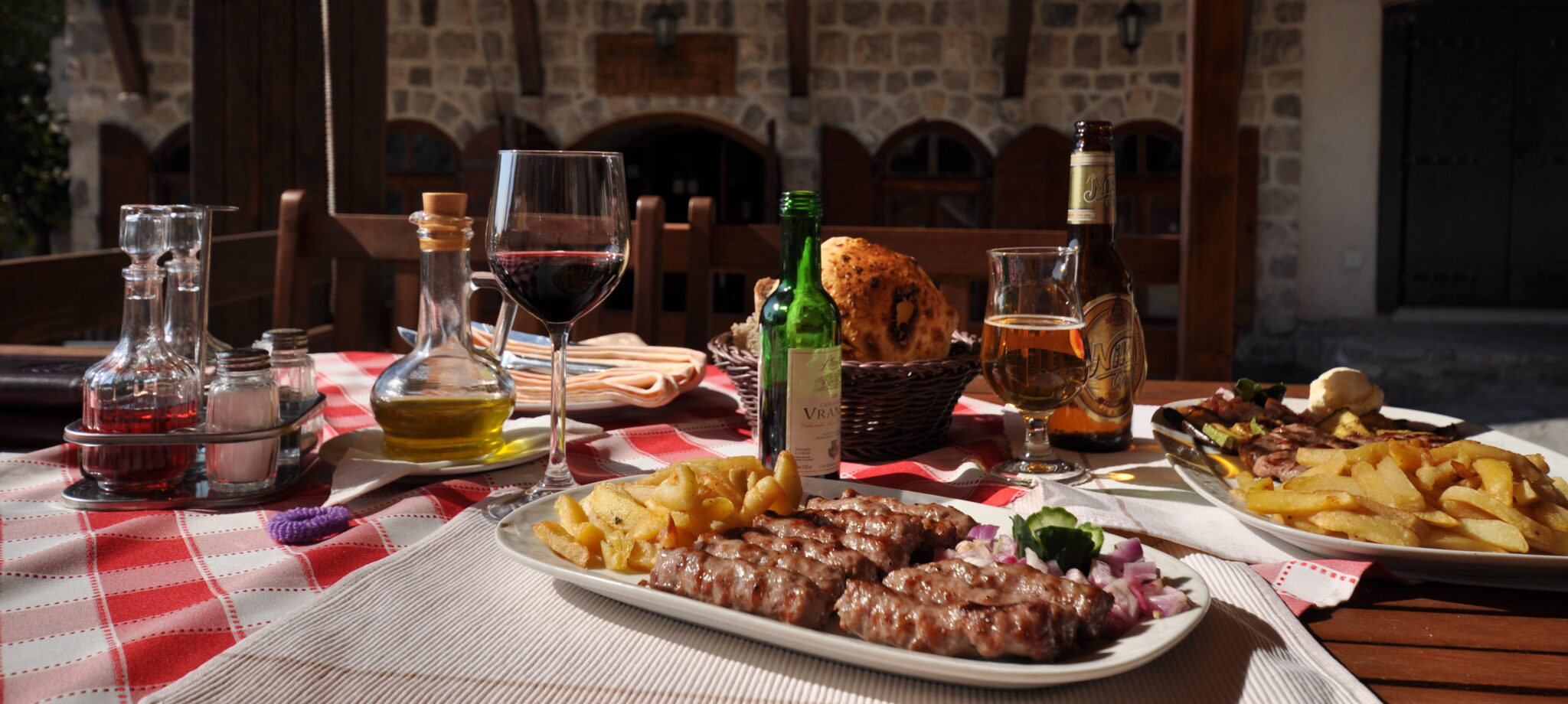
It looks like a couple of restaurants are open here, and women are pushing tables. Succumbing to the leisurely pace of life and in a philosophical mood, we don't dare disturb them and wait until Mala Plaza, where there are several pizzerias and a stunning view of the fortress. As usual, our restaurant choice was excellent – the pizza calzone is superb, the fish soup, and the "mesana salata" are worth every last crumb. Generally speaking, the food in Montenegro is delicious. I can't recall a single restaurant where we didn't like the food – almost everywhere everything is prepared in front of you, especially for you; they don't reheat it here. We enjoy the food and the views of the cliff and the fortress. Time to go home. We'll come back here to try the sand at Velika Plaza closer to summer. They say it has a special therapeutic effect.